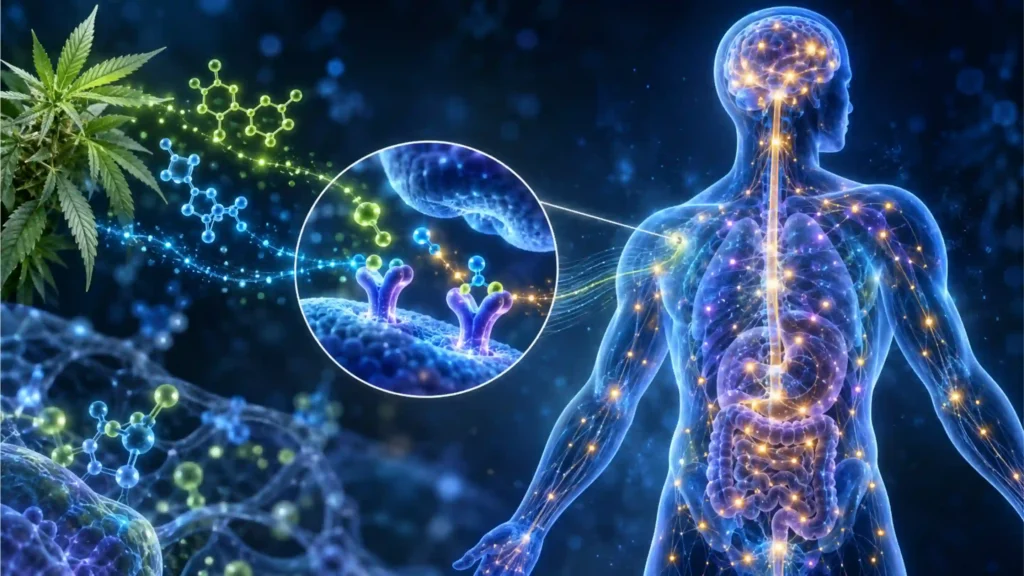
The endocannabinoid system, often shortened to the ECS, is a natural communication system found throughout your body. It helps regulate pain, sleep, mood, appetite, memory, inflammation, and how your body responds to stress.
Here’s the surprising part: you already have cannabinoids in your body, even if you’ve never used cannabis.
Your body makes its own cannabis-like chemicals called endocannabinoids. Cannabis works partly because compounds such as THC and CBD can interact with this same system.
Understanding the endocannabinoid system can make it much easier to understand how medical cannabis may affect the body—and why the effects can vary so much from one person to another.
What Is the Endocannabinoid System?
Think of the ECS as a giant communication network.
Your brain, nerves, immune system, digestive tract, and many other tissues constantly send messages back and forth. The endocannabinoid system helps control some of those messages and keeps them from becoming too strong or too weak.
One of its main jobs appears to be maintaining balance, sometimes called homeostasis.
Imagine the thermostat in your house. If the room gets too cold, the heat turns on. If it gets too warm, the heat shuts off.
The ECS isn’t literally a thermostat, but that’s a useful way to picture it. It helps the body adjust when conditions change.
Interested in learning more about the science behind the endocannabinoid system? Click HERE.
What Does the Endocannabinoid System Do?
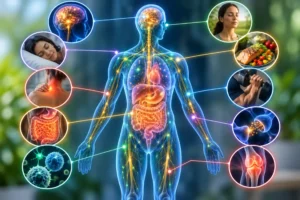
Scientists are still learning about the ECS, and we shouldn’t assume we fully understand every effect. Research suggests it plays a role in many important body functions.
These include:
- Pain perception
- Sleep and wake cycles
- Mood and stress responses
- Appetite
- Digestion
- Memory and learning
- Immune activity
- Inflammatory signaling
- Nausea and vomiting
- Muscle and nerve function
This wide reach helps explain why medical cannabis is being studied for so many different symptoms and conditions.
It doesn’t mean cannabis treats everything. Instead, cannabis interacts with a biological system that happens to be involved in many different parts of human health.
How Does the Endocannabinoid System Work?
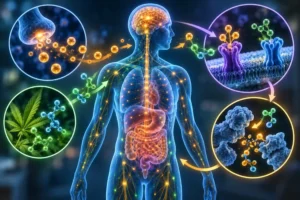
The easiest way to understand the ECS is to break it into three basic parts.
1. Endocannabinoids: The Messages
Endocannabinoids are chemicals your body makes naturally.
Two of the best-known are anandamide and 2-AG. You don’t need to remember those names. What matters is that your body can produce these chemicals when needed.
They act like short-lived messages that help cells communicate with one another.
2. Cannabinoid Receptors: The Receivers
A message isn’t very useful unless something can receive it. That’s where cannabinoid receptors come in.
The two best-known receptors are called CB1 and CB2.
CB1 receptors are especially common in the brain and nervous system. They’re involved in functions such as pain, movement, appetite, memory, and mood.
CB2 receptors are found largely in immune-related tissues, although they’re also present elsewhere in the body. They appear to play an important role in immune responses and inflammation.
Think of the endocannabinoid as a message and the receptor as the place where that message gets delivered.
3. Enzymes: The Cleanup Crew
Once an endocannabinoid has done its job, the body doesn’t necessarily leave it hanging around.
Special enzymes break it down.
That matters because the ECS is designed to respond to changing conditions. The body can create messages when needed and remove them when the job is done.
How Does THC Affect the Endocannabinoid System?
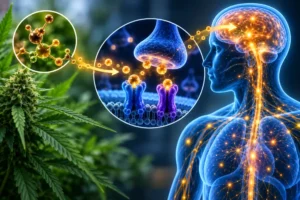
This is where medical cannabis enters the picture.
The cannabis plant produces chemicals called phytocannabinoids, meaning cannabinoids that come from a plant. THC and CBD are the two most familiar examples.
THC can activate CB1 receptors, including those in the brain. That’s one reason THC can influence pain, appetite, nausea, mood, and sleep.
It’s also why THC can cause intoxication.
Too much THC may lead to unwanted effects such as dizziness, anxiety, impaired coordination, rapid heart rate, or difficulty concentrating. More THC isn’t automatically better.
For medical patients, finding an appropriate dose is often more useful than simply choosing the strongest product available.
How Does CBD Affect the Endocannabinoid System?
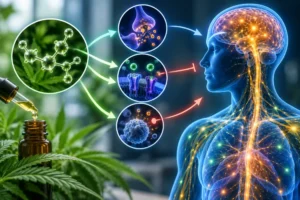
CBD works differently from THC.
It doesn’t strongly activate CB1 receptors in the same way, which is one reason CBD generally doesn’t produce the classic marijuana “high.”
Its biology is more complicated. CBD appears to influence the ECS indirectly and also interacts with several other signaling systems and receptors in the body.
Research is investigating CBD for areas including seizures, anxiety, inflammation, pain, and sleep. Evidence varies considerably depending on the condition, dose, and type of CBD product being studied.
That’s an important distinction. CBD isn’t simply THC without the high. They’re different compounds with different effects.
Why Does Cannabis Affect Everyone Differently?
Two patients can use the same cannabis product and have very different experiences.
One might feel relaxed and sleepy. Another may feel alert. Someone else could become uncomfortable or anxious.
Several things can influence the response, including:
- THC and CBD content
- Dose
- Method of use
- Previous cannabis exposure
- Age and body chemistry
- Other medications
- The symptom being treated
- Individual sensitivity to THC
Differences in the endocannabinoid system may also help explain some of this variation, although the science is still developing.
That’s why medical cannabis treatment often involves some trial and adjustment rather than a single product or dose that works for everyone.
Does Your Body Make Its Own THC?
No. This is a common misunderstanding.
Your body doesn’t naturally produce THC or CBD. It produces endocannabinoids, which can interact with some of the same receptors affected by cannabis.
THC happens to have a chemical structure that allows it to interact with this existing system.
In other words, cannabis didn’t create cannabinoid receptors in humans. The receptors were already there.
Can You Have an Endocannabinoid Deficiency?
You may come across the term clinical endocannabinoid deficiency online. The theory proposes that unusually low or altered endocannabinoid activity could contribute to certain health problems.
It’s an interesting area of research, but it hasn’t been established as a routine medical diagnosis.
There’s currently no standard blood test that tells a patient, “Your endocannabinoid system is low.” Claims that cannabis simply “fixes an ECS deficiency” go beyond what current evidence can prove.
Why Does the Endocannabinoid System Matter for Medical Cannabis Patients?

The ECS gives us a biological explanation for why cannabis can produce real effects in the human body.
THC isn’t simply creating random sensations. It interacts with receptors that are already part of normal human physiology. CBD influences some of these pathways differently and also affects signaling outside the traditional ECS.
For patients, the bigger lesson is simple: medical cannabis is complicated because the human body is complicated.
The goal isn’t to overwhelm the endocannabinoid system with as much THC as possible. A better approach is to choose cannabinoids, doses, and products carefully based on the patient’s symptoms, goals, medications, and response.
The Bottom Line
The endocannabinoid system is a natural part of your body. You have it whether you’ve used cannabis or not.
It helps regulate pain, appetite, sleep, mood, immune activity, and many other processes. Your body produces its own endocannabinoids, which communicate through receptors such as CB1 and CB2.
THC and CBD can influence this system in different ways. That interaction is one of the main reasons medical cannabis can affect such a wide range of symptoms—and why thoughtful dosing and medical guidance matter.
The more we learn about the endocannabinoid system, the easier it becomes to see medical cannabis for what it is: a therapeutic option that interacts with an existing human biological system, not a one-size-fits-all treatment.
Medical Disclaimer: This article is for educational purposes only and isn’t a substitute for professional medical advice, diagnosis, or treatment. Cannabis can cause side effects and interact with medications. Talk with a qualified healthcare professional before starting or changing a medical cannabis treatment plan.

Dr. Nicholas Marsh is board-certified by the American Board of Anesthesiologists and has over 37 years of healthcare experience. Recognized by FindaTopDoc.com for clinical excellence, he now focuses on educating, supporting, and certifying patients for medical cannabis.