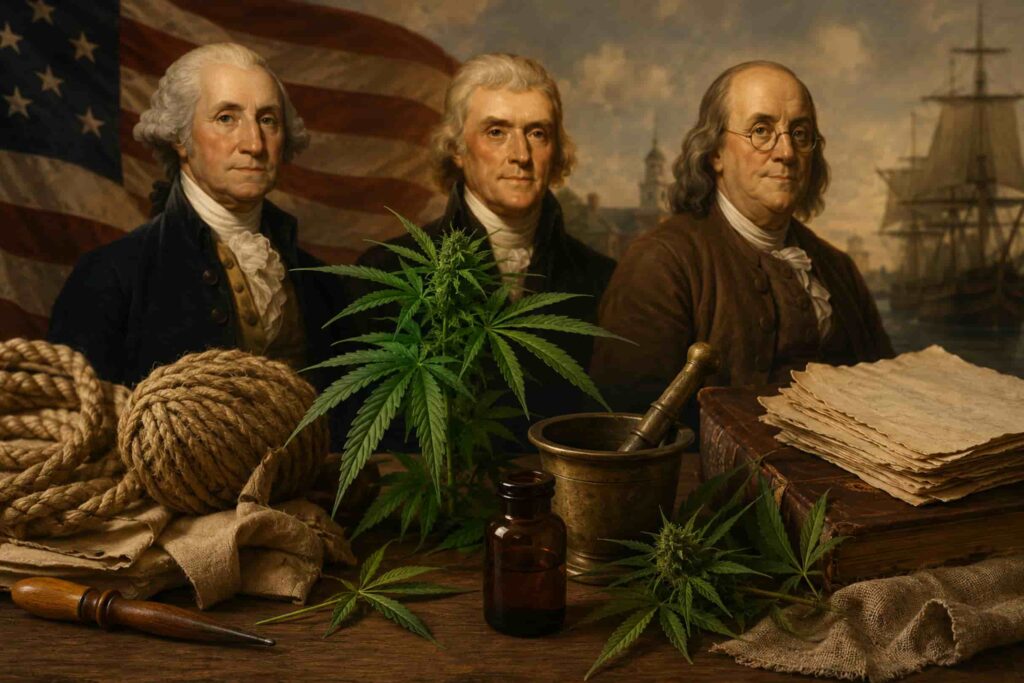
As America celebrates 250 years of independence, many people are taking a fresh look at the ideas and values of the nation’s Founding Fathers. We often think about their views on liberty, government, and individual rights. But one question that surprises many people is this:
What did the Founding Fathers think about cannabis?
The answer is more interesting than many people expect.
The cannabis plant was well known throughout colonial America. However, the Founding Fathers did not view it the same way many people do today. In the 1700s, cannabis was primarily valued as hemp—an important agricultural crop used to make rope, sails, paper, clothing, and other essential products. At the same time, physicians of the era were familiar with the plant’s medicinal properties, although modern medical cannabis programs would not appear until centuries later.
Understanding this history helps separate fact from fiction and shows that cannabis has long been part of American life.
Hemp Was an Essential Colonial Crop
When the United States was founded, hemp was one of the most useful crops grown in North America.
Strong hemp fibers were used to manufacture:
- Rope for ships
- Canvas sails
- Fishing nets
- Clothing
- Paper
- Animal feed
- Industrial textiles
Without hemp, the eighteenth-century shipping industry would have struggled to operate. Naval vessels, merchant ships, and fishing fleets all relied heavily on hemp products.
For this reason, colonial governments often encouraged farmers to grow hemp. In some colonies, it was considered so important that laws promoted or even required its cultivation during certain periods.
This agricultural importance explains why many early American leaders were familiar with the cannabis plant long before modern debates over marijuana ever existed.
George Washington Grew Hemp
Perhaps the most famous example is George Washington.
Washington grew hemp at his estate, Mount Vernon, along with wheat, corn, tobacco, and numerous other crops.
His farm journals include multiple references to planting, harvesting, and processing hemp.
Modern internet myths sometimes claim that Washington grew cannabis primarily for recreational purposes. There is no credible historical evidence to support that claim.
Instead, historians generally agree that Washington cultivated hemp as an agricultural commodity because of its economic value. Like many successful farmers of his time, he experimented with different crops to improve productivity and profitability.
His writings demonstrate that hemp was viewed as an ordinary and valuable farm crop.
Thomas Jefferson Also Cultivated Hemp
Thomas Jefferson likewise grew hemp at Monticello.
Jefferson had a lifelong interest in agriculture and frequently experimented with new farming techniques and crops.
Historical records show that hemp was among the plants he cultivated.
Jefferson even developed improvements to equipment used for processing hemp fibers, reflecting the crop’s economic significance.
Like Washington, there is no reliable evidence that Jefferson promoted recreational cannabis use. Instead, his interest centered on hemp as a valuable agricultural resource.
Benjamin Franklin Helped Produce Hemp Paper
Another Founding Father connected to hemp was Benjamin Franklin.
Franklin owned one of America’s earliest paper mills, and hemp fiber was among the raw materials commonly used in papermaking at the time.
Before wood pulp became the dominant source of paper in the nineteenth century, hemp and linen rags were widely used for producing durable paper.
Many important colonial documents—and countless books—were printed on paper made partly from hemp fibers.
Although the U.S. Constitution and Declaration of Independence were written on parchment rather than hemp paper, hemp played an important role in the printing industry, helping spread revolutionary ideas throughout the colonies.
Cannabis Was Also Used as Medicine
While hemp dominated agricultural discussions, cannabis also had a place in medicine.
For centuries, physicians around the world had used preparations derived from cannabis to help relieve symptoms such as:
- Chronic pain
- Muscle spasms
- Poor appetite
- Sleep disturbances
- Digestive complaints
During the colonial period, medical practice was very different from today’s evidence-based medicine. Doctors relied heavily on herbal remedies because modern pharmaceuticals had not yet been developed.
Cannabis was one of many botanical medicines available, alongside willow bark, foxglove, opium poppies, and numerous other medicinal plants.
Although the Founding Fathers themselves left very little written discussion about cannabis as a medicine, physicians of their era would have recognized the plant as having therapeutic potential.
The Modern Debate Came Much Later
One important historical point is that today’s political debates over cannabis would have been unfamiliar to the Founding Fathers.
During the late eighteenth century:
- Cannabis was not a major political issue.
- Hemp was considered an ordinary farm crop.
- Physicians used many plant-based medicines.
- There were no nationwide prohibitions on cannabis.
The widespread criminalization of marijuana did not begin until the twentieth century, more than 140 years after the signing of the Declaration of Independence.
In other words, the legal and cultural arguments surrounding cannabis today developed long after the nation’s founding.
What Might the Founding Fathers Think Today?
Of course, no one can say with certainty how Washington, Jefferson, Franklin, or the other Founders would approach today’s medical cannabis programs.
History cannot answer hypothetical questions.
However, we can make a few careful observations.
The Founding Fathers generally valued:
- Scientific inquiry
- Agricultural innovation
- Individual liberty
- Practical problem-solving
- Limited government in many areas of daily life
Many of them were enthusiastic experimenters who embraced new farming methods, new technologies, and advances in medicine.
It is reasonable to think they would have expected modern policymakers to evaluate cannabis based on the best available scientific evidence rather than rumor or fear. Beyond that, any claim about what they “would have supported” is speculation.
Modern Medical Cannabis Is Very Different
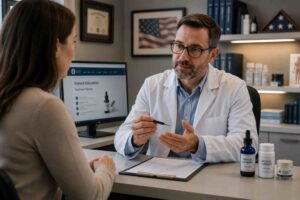
Today’s medical cannabis programs bear little resemblance to eighteenth-century herbal medicine.
Modern physicians have access to:
- Standardized cannabis products
- Laboratory testing
- Accurate dosing information
- Quality control standards
- Ongoing clinical research
- Careful patient monitoring
Patients can also choose from a variety of formulations—including oils, capsules, tinctures, vaporized products, topical preparations, and other options—allowing treatment to be tailored to individual medical needs.
While research continues to evolve, growing evidence suggests that medical cannabis may help some patients manage chronic pain, muscle spasticity, chemotherapy-related nausea, epilepsy, and several other conditions when used under appropriate medical supervision.
Looking Back While Moving Forward
The 250th anniversary of America’s founding offers an opportunity to appreciate the complex history of cannabis in the United States.
The Founding Fathers did not know cannabis as a modern political issue. They knew it primarily as hemp—an essential crop that supported agriculture, shipping, manufacturing, and commerce.
At the same time, physicians of their era understood that cannabis had medicinal properties, even if they lacked the scientific tools available today.
Modern medical cannabis programs represent the next chapter in that long history. Rather than relying solely on tradition, today’s physicians combine centuries of historical experience with modern clinical research to help determine when medical cannabis may be appropriate.
As our understanding continues to grow, one lesson from the Founding Fathers remains especially relevant: progress often comes from questioning assumptions, studying the evidence, and remaining open to new knowledge.
For patients exploring whether medical cannabis may be right for them, the most important step is speaking with a qualified healthcare professional who can provide individualized guidance based on current medical evidence, state law, and each patient’s unique health needs.
Disclaimer: This article is for educational purposes only. Always consult a qualified healthcare provider with any questions about your health or medical conditions.

Dr. Marsh, is a board-certified anesthesiologist with over 37 years of healthcare experience. A graduate of Syracuse University, the New York College of Osteopathic Medicine, and Rutgers University Medical School, he has earned recognition from FindaTopDoc.com for clinical excellence. Dr. Marsh founded ReThink-Rx in 2021, where he now focuses on educating, supporting, and certifying patients for medical cannabis.