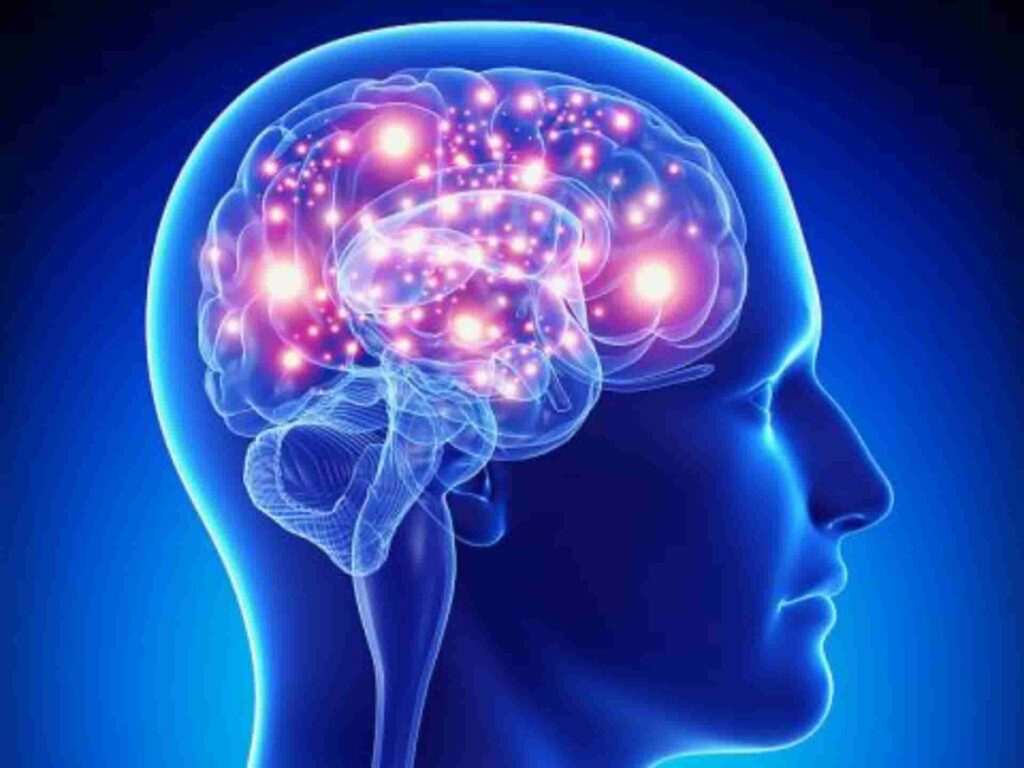
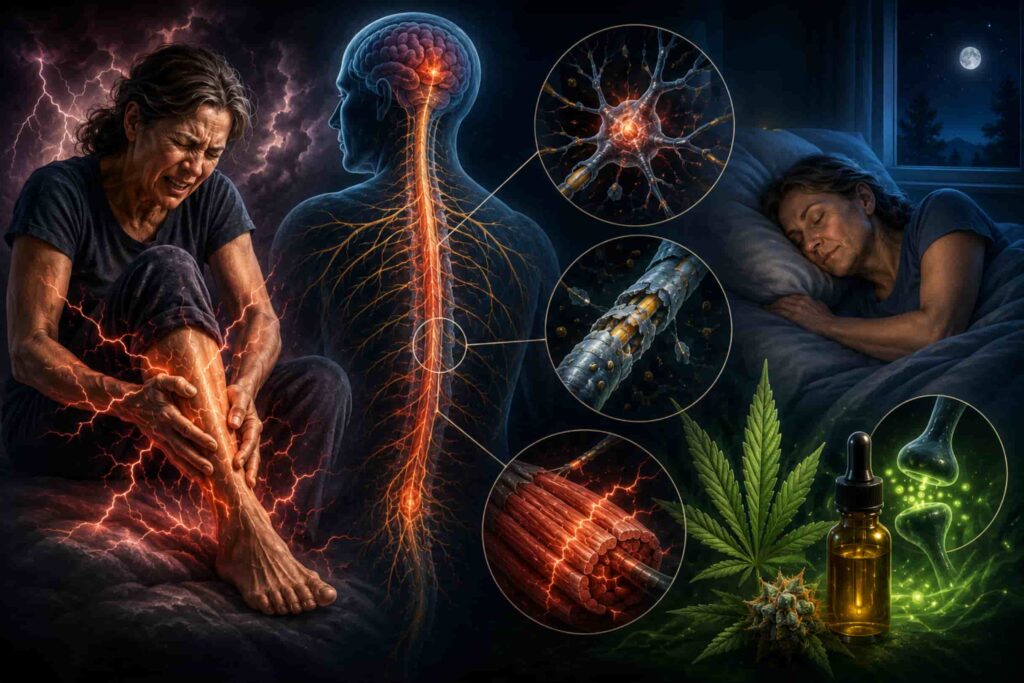
Spasticity is one of the most common and challenging symptoms experienced by people living with multiple sclerosis (MS). For many patients, it is not just an inconvenience—it is a daily source of pain, stiffness, sleep disruption, and functional limitation. Spasticity can interfere with walking, dressing, transferring, and even resting comfortably, making effective management essential to maintaining quality of life.
While conventional medications remain the first line of treatment, they do not work for everyone and are often limited by side effects. As a result, many patients with MS-related spasticity are exploring whether medical cannabis may offer additional relief as part of a comprehensive care plan.
What Is Spasticity in Multiple Sclerosis?

Spasticity refers to abnormal muscle tightness caused by disrupted communication between the brain, spinal cord, and muscles. In MS, damage to myelin alters the signals that normally tell muscles when to contract and relax. The result is excessive muscle tone that muscles cannot easily “turn off.”
Spasticity may present as:
- Persistent muscle stiffness
- Sudden muscle spasms or jerking
- Painful cramping
- Involuntary leg or arm movements
- Difficulty bending joints
-
Increased symptoms at night or with fatigue
Spasticity often fluctuates and may worsen with stress, infection, poor sleep, or prolonged immobility.
Why Spasticity Is So Disruptive
Unlike isolated pain, spasticity affects multiple aspects of daily life at once. Muscle tightness can restrict movement, increase fall risk, and make physical therapy more difficult. Painful spasms frequently interrupt sleep, leading to fatigue that further worsens muscle control the following day.
Over time, unmanaged spasticity can lead to muscle shortening, joint contractures, and loss of mobility. Effective symptom control is not just about comfort—it is about preserving long-term function.
Conventional Treatments and Their Limitations
Standard medical treatments for MS-related spasticity often include muscle relaxants, antispasmodic medications, benzodiazepines, and physical therapy. While these approaches can help, they frequently come with drawbacks:
- Sedation and mental clouding
- Dizziness and balance issues
- Weakness that worsens mobility
- Tolerance and reduced effectiveness over time
-
Limited benefit for nighttime symptoms
Many patients find that medications reduce spasticity at the cost of alertness or strength, creating a difficult tradeoff.
The Endocannabinoid System and Muscle Tone
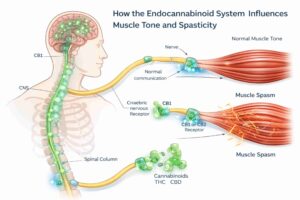
Medical cannabis works through the endocannabinoid system (ECS)—a regulatory system involved in nerve signaling, muscle tone, reflex control, pain perception, and sleep. Cannabinoid receptors are abundant in the brain and spinal cord, including regions involved in motor control.
In MS, spasticity arises from excessive nerve signaling and loss of inhibitory control. Cannabinoids may help restore balance by modulating these overactive pathways rather than simply suppressing muscle activity.
How Cannabis May Reduce Spasticity
Research and patient reports suggest that medical cannabis may help MS-related spasticity through several mechanisms:
- Reducing excessive nerve firing that triggers involuntary muscle contraction
- Calming reflex loops in the spinal cord
- Improving coordination between opposing muscle groups
-
Decreasing spasm frequency and intensity
Many patients describe muscles feeling “less locked,” with smoother movement and fewer sudden spasms.
Pain Relief and Spasticity Go Hand in Hand
Spasticity is often painful, especially when muscles remain contracted for long periods. This pain can further increase muscle guarding, creating a cycle of tightening and discomfort.
Cannabis may help break this cycle by:
- Reducing spasticity-related pain
- Modulating nerve pain that overlaps with muscle tightness
-
Allowing muscles to relax more fully
Improved pain control often leads to better movement tolerance and greater participation in physical therapy.
Nighttime Spasticity and Sleep
Spasticity frequently worsens at night. Changes in body position, fatigue, and reduced sensory input can trigger spasms that interrupt sleep. Poor sleep then worsens spasticity the next day.
Medical cannabis may improve nighttime symptoms by:
- Reducing nocturnal muscle spasms
- Calming nervous system hyperactivity
-
Supporting longer, more continuous sleep
Better sleep often leads to improved daytime muscle control, mood, and resilience.
Cannabis Compared to Traditional Spasticity Medications
Many medications used for MS spasticity act as central nervous system depressants. While effective for some patients, they may cause excessive weakness or sedation.
Medical cannabis may offer several advantages for select patients:
- Muscle relaxation without profound sedation
- Lower risk of respiratory depression
- Less impact on cognitive function at appropriate doses
-
Potential to address multiple symptoms simultaneously (spasticity, pain, sleep)
For some patients, cannabis allows dose reduction of other medications under medical supervision.
Individualized Therapy Is Essential
Not all cannabis products affect spasticity the same way. Outcomes depend on:
- THC-to-CBD ratio
- Presence of minor cannabinoids
- Dose and timing
-
Method of administration
Lower doses are often sufficient, particularly for spasticity and nighttime symptoms. Higher doses are not always better and may worsen balance or cognition.
Careful titration and physician guidance are critical to safe and effective use.
A Complement, Not a Replacement

Medical cannabis does not cure MS or replace disease-modifying therapies. Its role is supportive—helping manage spasticity so patients can move more comfortably, sleep better, and maintain function.
When combined with physical therapy, stretching, mobility aids, and neurologic care, cannabis may be an important part of a comprehensive spasticity management strategy.
Final Thoughts
Spasticity is one of the most impactful symptoms of multiple sclerosis, affecting comfort, mobility, sleep, and independence. While conventional treatments remain essential, they are not always sufficient or well-tolerated.
Medical cannabis offers a different approach—one that targets abnormal nerve signaling, muscle tone, pain, and sleep through the body’s own regulatory systems. For appropriately selected patients, it may provide meaningful relief with a safety profile that compares favorably to many traditional options.
As with all MS therapies, success depends on individualized care, education, and ongoing medical oversight. When used thoughtfully, medical cannabis may help patients with MS-related spasticity move more freely and live more comfortably—day and night.
Disclaimer: This article is for educational purposes only and is not a substitute for professional medical advice, diagnosis, or treatment. Always consult a qualified healthcare provider with any questions about your health or medical conditions.

Dr. Marsh, is a board-certified anesthesiologist with over 37 years of healthcare experience. A graduate of Syracuse University, the New York College of Osteopathic Medicine, and Rutgers University Medical School, he has earned recognition from FindaTopDoc.com for clinical excellence. Dr. Marsh founded ReThink-Rx in 2021, where he now focuses on educating, supporting, and certifying patients for medical cannabis.